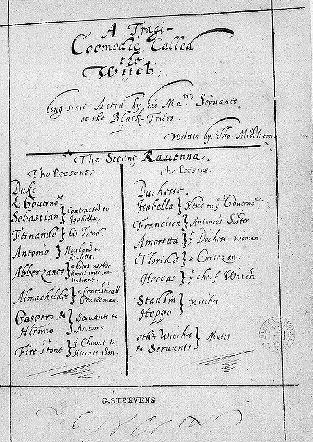
The Witch is a Jacobean play, a tragicomedy written by Thomas Middleton. The play was acted by the King's Men at the Blackfriars Theatre. It is thought to have been written sometime between 1609 and 1616; it was not printed in its own era, and existed only in manuscript until it was published by Isaac Reed in 1778.
Synopsis
Act 1, Scene 1: Urbino, Italy; The grounds of the Lord Governor's house; the day of Antonio and Isabella's wedding; a banquet laid out
The play opens with the protagonist Sebastian conversing with his friend Fernando. Sebastian has been absent from Urbino, soldiering in the wars of Northern Italy for three years, and has falsely been reported killed. His fiancee Isabella has—this very day—married the powerful aristocrat Antonio. According to the Renaissance custom of handfast, Sebastian regards Isabella as his wife in the sight of Heaven.
Desperately worried that Isabella will consummate her marriage to Antonio that night, Sebastian tells Fernando that he is willing to go to any means in order to reclaim her. He exits. Fernando delivers a short speech sympathizing with his friend's predicament. Antonio's servant Gaspero enters with another servant. Fernando exits. Gaspero says that Fernando's behavior at the wedding banquet was very suspicious—he did not raise his glass to toast the new couple even once, and declined to drink any of the fine wine on offer. Antonio's courtesan (prostitute) Florida enters.
She is upset that Antonio has married another woman. Gaspero tries to console her by assuring her that Antonio will continue sleeping with her after he has grown tired of his new wife. He instructs her to retire to a private parlor and promises to bring her some delicacies from the wedding banquet soon. Florida exits. Almachildes ("a fantastical gentleman") enters with Amoretta (the Duchess's woman). Almachildes tries to get Amoretta to kiss him. Amoretta resists. Almachildes plans to go to "the witches" to procure a charm to make Amoretta fall in love with him. He exits. The wedding party enters with servants bearing a banquet.
The wedding party includes the Duke, the Duchess, the Lord Governor, Antonio, Isabella, and Francisca (Antonio's sister). The Duke has had a goblet made from the skull of his wife's father (a defeated enemy). He uses the skull goblet to pledge toasts, passing it around among the assembled guests. The Duchess is disgusted by the goblet, but she conceals her disdain. In an aside, she says that she has already decided upon her revenge.
Act 1, Scene 2: Hecate's cave
Hecate (the chief witch) enters carrying serpents and an "unbaptized brat." Her assistant Standlin enters bearing a brass dish. Hecate hands the baby over to Standlin and instructs her to boil it.
She notes that the baby's fat will be used to make a transvection ointment that enables the witches to fly at night, transform themselves into incubi and have sex with young men. Hecate and Stadlin also discuss a "heart of wax stuck full of magic needles"—a charm that will be used to lay a curse on the livestock of a farmer whom Hecate bears a grudge against. Stadlin exits with the baby. Hecate squeezes the snakes into the brass dish and lays their skins aside (to be used for Sebastian's charm later on).
Hecate's son Firestone enters. Hecate tells him that she only has three more years until her 120 years of life (allotted to her by the devil) will be up. She gives him the brass dish and tells him that it is filled with "dear syrup"—a single drop of the stuff is enough to "confound a family of nineteen." Firestone asks Hecate's permission to go out with the Nightmare (a monster that suffocates people in their sleep by sitting on their chests). He says that he wants to use the monster to "overlay a fat parson's daughter." Hecate gives him her permission. Firestone exits with the brass dish. Sebastian enters and asks Hecate to make Antonio impotent so he won't be able to have sex with Isabella.
Hecate gives him a charm made from the skins of lizards and snakes. Sebastian exits. Almachildes enters soon thereafter, very drunk. He gives Hecate a toad and asks her for a love charm (to be used on Amoretta). Pleased with the toad, Hecate invites Almachildes to dinner. A cat playing a fiddle (Malkin) enters, followed by spirits bearing plates of fine meat.
Act 2, Scene 1: Antonio's house; the morning after the wedding
Antonio is extremely glum because Hecate's charm made him impotent on his wedding night. Gaspero asks the cause of his sadness. Antonio avoids his questions and orders him to bring some chicken broth (a cure for impotence) and "half an ounce of pearl" (an aphrodisiac). Antonio exits. Gaspero mistakenly assumes that Antonio needs chicken broth and pearl because he has contracted a venereal disease from his new wife. Francisca (Antonio's younger sister, a maid) enters. She asks Gaspero about Antonio's sour mood. Gaspero exits quickly without telling her anything. Left alone on stage, Francisca delivers a soliloquy in which she reveals that she has been receiving secret nighttime visits from a "friend" (Aberzanes) who has got her pregnant.
She worries that Antonio will kill her if the pregnancy is discovered. Isabella enters. She encourages Francisca to get married so she can discuss matters of a marital nature with her (Antonio's impotency is obviously on her mind). Francisca says that Isabella is lucky to have found a husband like her brother—he doesn't gamble or chase women, and he has promised to give up tobacco for Isabella's sake. Isabella agrees that Antonio was a good catch. Antonio enters. Isabella tells him that she has been encouraging Francisca to get married.
Antonio says that Francisca is too young to get married. Isabella sings a song for Antonio. The lyrics of the song slyly allude to the plights of Isabella, Amoretta and Francisca. Aberzanes ("a gentleman, neither honest, wise nor valiant") enters. He is followed by servant carrying copious quantities of food and drink (an indication of his gluttonous nature). Speaking aside, Francisca asks Aberzanes what he plans to do about her pregnancy. She warns him that she might give birth that very night. Aberzanes tells her not to worry and assures her that he has already taken care of everything.
Sebastian enters disguised as a servant, "Celio." Isabella introduces "Celio" and says that she has just hired him that very morning. Antonio welcomes "Celio" to the household. "Celio" announces the arrival of a gentleman who has brought a letter from Antonio's mother in Northern Italy. Antonio reads the letter aloud. In the letter, "Antonio's mother" asks Antonio to send Francisca to Northern Italy immediately. (The letter is in fact a forgery by Aberzanes—this is his way of getting Francisca out of the house so she can give birth in secret.) Antonio orders Francisca to leave immediately. Francisca thanks Aberzanes in an aside.
Antonio, Isabella and the Gentleman exit. Aberzanes tells Francisca that he has made all of the necessary preparations for her journey. Aberzanes and Francisca exit. Left alone on stage, Sebastian deduces from Antonio's discontented demeanor that Hecate's charm has taken effect. He is pleased, but even more desperate than before to get Isabella back. At the end of the scene, Gaspero enters with the Lord Governor (Isabella's uncle), who has come to pay Antonio a visit.
Act 2, Scene 2: The Duke's palace
Almachildes regretfully recalls his drunken dinner with the witches. He discovers Hecate's charm in his pocket and decides to try it out. Amoretta enters. Almachildes embraces her and secretly slips the charm into the bodice of her dress. Amoretta pushes Almachildes away. Almachildes exits. As the charm begins to work, Amoretta has a sudden change of heart and declares that Almachildes is "the sweetest gentleman in court." In a short speech, she reveals that the Duchess has ordered her to get close to Almachildes so he can be used in an undisclosed "employment" (the Duchess wants to get Almachildes to help her kill the Duke).
Amoretta says she was initially averse to the idea of getting close to Almachildes, but she now looks forward to the task with great relish. The Duchess enters. In an aside, she complains once again about the Duke's morbid skull goblet. She asks Amoretta if she has managed to arrange a meeting with Almachildes yet. Amoretta says that she could never do anything to deceive Almachildes, but declares her willingness to become his honest wife. The Duchess wonders if Amoretta has lost her mind. The charm falls from Amoretta's dress to the floor, and the Duchess picks it up—thereby transferring the love spell from Amoretta to the Duchess. Amoretta immediately declares her complete hatred for Almachildes; the Duchess declares her love for him.
Amoretta agrees to deceive Almachildes as the Duchess had previously ordered. The Duchess looks forward to tasting the sweetness of revenge and love combined. She exits. Almachildes enters. Amoretta flirts with him and promises to meet him soon. Almachildes assumes that Hecate's charm has done its trick.
Act 2, Scene 3: A farmhouse
Francisca has had her baby. Aberzanes pays an old woman to raise the child in secrecy. Aberzanes and Francisca prepare to return to Urbino. Francisca examines her reflection in a mirror. She is surprised to see how pale and thin she has grown.
Act 3, Scene 1: The Duke's palace
The Duchess has tricked Almachildes into having sex with her by blindfolding him and pretending to be Amoretta. The scene begins as she removes the blindfold. She tells Almachildes that she will marry him if he helps her kill the Duke—but threatens to accuse him of rape if he refuses. Almachildes agrees to help her kill the Duke.
Act 3, Scene 2: The grounds of Antonio's house
Gaspero helps Florida sneak into the house for rendezvous with Antonio. Sebastian enters (posing as "Celio") as Florida heads off to Antonio's bedroom. "Celio" asks Gaspero who Florida is. Gaspero tells him that she is Antonio's mistress, and that she has visited the house three times in the past ten days (it seems that Hecate's impotency charm only impedes Antonio's ability to have sex with Isabella). Isabella enters. She scolds "Celio" and Gaspero for loitering around. "Celio" and Gaspero exit. Isabella soliloquizes about a letter she has found that reveals the details of Francisca's sexual dalliances. She is mad at Francisca for betraying Antonio's trust, but decides to keep the information a secret. Isabella enters with Aberzanes (supposedly returning from Northern Italy). Isabella notices that Francisca has lost a great deal of weight in a short amount of time. Aberzanes says that Francisca is merely tired after the long journey. He exits.
Isabella confronts Francisca with the letter and insists that she leave Antonio's house immediately. Isabella exits. In a soliloquy, Francisca decides to protect herself against exposure by spreading lies about Isabella. Antonio enters. Francisca tells him that Isabella has been having an affair with Gaspero. Antonio buys her story completely. Francisca exits. Isabella enters. Antonio tells Isabella that he has to go away on business for two weeks (in fact, he wants to create an opportunity for Isabella to cheat on him so he can catch her red-handed). Antonio exits. "Celio" enters.
He tells Isabella about Antonio's relationship with Florida. Isabella (who has become dissatisfied with her marriage as a result of Antonio's impotency) promises to reward "Celio" handsomely if he can prove that his allegations against Antonio are true. "Celio" says that he has made a plan to sneak Isabella out of the house so she can catch Antonio red-handed. Isabella agrees to go along with his plan.
Act 3, Scene 3: A forest glade
Hecate, Hoppo and Stadlin prepare for a nighttime flight. Hoppo and Stadlin take off. Hecate promises to catch up with them soon. Firestone brings Hecate a basket filled with lizards, snake's eggs and herbs cropped by moonlight. Voices from offstage bid Hecate to hurry up and join the nighttime flight.
The voices sing the song "Come Away, Come Away" (which also appears in Macbeth). A "Spirit like a cat" (Malkin) descends as the voices sing. Hecate ascends with the Cat, extolling the expected pleasures of her nighttime ride.
Act 4, Scene 1: The Duke's palace
Almachildes delivers a soliloquy in which he reveals that he has helped the Duchess kill the Duke. As a result, a popular uprising has broken out in opposition to the Duchess' ascent to power. Almachildes regrets his role in the Duke's murder and worries that he will become the Duchess' next victim. The Duchess enters. She tells Almachildes that she is afraid for his safety.
She advises him to lay low for a while and promises to marry him as soon as public sentiment cools down. Almachildes agrees to follow the Duchess' advice, but expresses skepticism of her intentions in an aside. Almachildes exits. In a short soliloquy, the Duchess says that Almachildes must die as soon as possible (she wants to kill him in order to conceal her complicity in the Duke's murder).
She makes plans to win the love of the Lord Governor, whom she hopes will intervene on her behalf to calm the insurrection. The Lord Governor enters. The Duchess promises to love him if he will help her win public favor. The Lord Governor promises to help her, kisses her hand, and exits. In a final soliloquy, the Duchess looks forward to marrying the Lord Governor and redoubles her resolve to get rid of Almachildes immediately.
Act 4, Scene 2: Fernando's house
Sebastian tells Florida and Fernando about his convoluted scheme to lure Isabella into bed and deflower her. The details of the scheme are as follows:
Posing as "Celio," Sebastian has told Isabella to go to Fernando's house, where, according to "Celio's" plan, she will pose as Antonio's mistress in an attempt to attain solid evidence of Antonio's adulterous affairs. Fernando's house is a sort-of brothel where Florida has a room. Sebastian expects Isabella to arrive at the house shortly. When she arrives, Fernando will send her to Florida's bed so she can pose as Florida and have sex with "Antonio," who will actually be Sebastian posing as Antonio. Florida has agreed to vacate her bedroom so she can sneak back to Antonio's house and have sex with Antonio while Isabella is gone (she also hopes to help disgrace Isabella so that she can have Antonio to herself). As she leaves Fernando's house, Florida is instructed to tell Isabella (who will be approaching the house as she leaves) that she knows Antonio well and that he visits the house quite often. Fernando is instructed to back up Florida's claims, thereby increasing Isabella's mistrust of Antonio.
Fernando and Florida agree to follow Sebastian's plan. Florida exits to meet Isabella. Isabella knocks at the door. Sebastian exits to an adjoining room to observe. Isabella enters. Fernando agrees to direct her to Antonio's room. Isabella curses Antonio and says that she would have never found herself in such a miserable situation if her first husband (Sebastian) had lived. Isabella and Fernando exit.
Sebastian enters. Moved by Isabella's remembrance of him, he decides that it would be wrong to deceive her. Isabella enters. She accuses Sebastian ("Celio") of deceiving her because Antonio was not in Florida's bedroom. "Celio" encourages Isabella to wait. He is reluctant to send her back home for fear she would discover Florida in her bed. Isabella agrees to wait for a while.
Act 4, Scene 3: Antonio's house
Francisca starts the scene off with a soliloquy. She expects Antonio to arrive home shortly, and has made plans to arrange things so he will catch Gaspero and Isabella in bed together. When she hears the sound of Antonio's arrival, she calls for Gaspero. Gaspero enters undressed. Francisca tells him that Isabella has been calling for help, but none of her maidens have gone to her aid (Francisca drugged all of Isabella's maidens to make sure they would stay asleep). She urges Gaspero to go to Isabella's room immediately.
Gaspero says that he has to get dressed first. Francisca tells him not to bother. Gaspero goes to Isabella's room. Antonio enters. Francisca encourages him to search Gaspero's room. Antonio does as she says and finds the room empty. Convinced that Gaspero must be sleeping with his wife, Antonio draws his sword and heads to the bedroom. He returns moments later with a bloody sword, claiming to have stabbed Gaspero and Isabella (in fact, he has stabbed Gaspero and Florida—Isabella is at Fernando's house with Sebastian).
He tells Francisca to come down from the balcony so he can kill her too. Raving, he explains that she must die as well because she was the one who brought him the news of Isabella's betrayal. Fearing for her life, Francisca admits that she made the entire story up to conceal the illegitimate child she had with Aberzanes. This revelation stuns Antonio and plunges him into an even deeper grief. He puts his sword down and sends a servant to summon Aberzanes.
Act 5, Scene 1: Antonio's house
Aberzanes arrives at Antonio's home. Antonio urges him to draw his sword and fight, but Aberzanes refuses. Francisca enters. Antonio forces Francisca and Aberzanes to kneel and perform a handfast (engagement) ceremony. To conclude the ceremony, he orders the couple to drink some poisoned wine. He also drinks the wine himself—a suicidal act that is not in fact suicidal because the servant, Hermio, disobeyed Antonio's orders and refrained from poisoning the wine. Antonio and Francisca exit after the handfast ceremony is completed.
In a soliloquy, Antonio wonders if his ruined marriage might be some sort of karmic retribution. He reveals that he falsified reports of Sebastian's death so he could marry Isabella. A servant enters and reports that Gaspero and "Isabella" (actually Florida) are merely wounded, not dead. Gaspero enters wounded. He tells Antonio that the woman in his room was Florida, not Isabella. Assuming that Isabella is out having sex with another man, Antonio prays aloud that the (actually not) poisoned wine will not take effect until he can find his wife and kill her. Hermio tells him that the wine wasn't actually poisoned. Antonio thanks Hermio. The Lord Governor enters. Antonio tells the Lord Governor that (his niece) Isabella is an "impudent adulteress."
The Lord Governor demands proof of Antonio's allegations. Florida enters, wounded, ans says that Isabella is sleeping with her servant "Celio" at Fernando's house. Antonio rushes off to Fernando's house in a rage. Gaspero and Florida exit to see a doctor. The Lord Governor follows them. The servant Hermio is left alone on stage. Isabella enters with "Celio" (Sebastian) and casually asks Hermio if Francisca is still sleeping. Hermio tells Isabella that there has been a great deal of commotion as a result of her absence and that Antonio has gone to Fernando's house to find her. Isabella blames "Celio" (Sebastian) for staining her reputation. Sebastian worries that his foolhardy scheme has caused Isabella's ruin.
Act 5, Scene 2: Hecate's cave, a cauldron set
The Duchess goes to Hecate to procure a "sudden, subtle" poison for Almachildes. Hecate offers her a voodoo portrait of Almachildes that will kill him slowly. The Duchess rejects the portrait because it would take too long. She also insists that the method of poisoning must be subtle. Hecate becomes impatient with the Duchess' impertinence and recites a charm in Latin (quoted from Ovid). The Duchess apologizes.
Hecate assures the Duchess that Almachildes will die that evening. The Duchess exits. Hecate orders Firestone to bring her some lizard's brain, bear breach and "three ounces of the red-haired girl I killed last midnight." These ingredients are stirred together in a pot with bat's blood, libbard's bane, the juice of a toad, and the oil of an adder. Hecate sings a charm song and the other witches perform a dance for the moon.
Act 5, Scene 3: Antonio's house
Back at Antonio's house, Isabella explains the story of her absence to the Lord Governor. The Lord Governor scolds "Celio" for providing Isabella with false intelligence and leading her into a compromising situation. Hermio enters and announces that Antonio fell through a trap door and fell to his death while searching through Fernando's house for Isabella. The Lord Governor says that Antonio got what he deserved. Isabella forgives Antonio for his marital transgressions. Florida faints. Some servants carry Florida away. The Lord Governor resumes pronouncing judgment on "Celio." "Celio" removes his disguise to reveal that he is actually Sebastian.
Isabella expresses joyous disbelief. The Lord Governor welcomes Sebastian happily. Gaspero admits that Antonio paid him to give false reports of Sebastian's death. The Duchess enters. The Lord Governor reveals the body of the Duke (it has presumably been concealed in a curtained-off space up to this point) and charges the Duchess with adultery and murder. The Duchess admits to the murder, but denies the charge of adultery. The Lord Governor calls for Almachildes. Almachildes enters (Hecate's poison is apparently either ineffective or has yet to take effect). Almachildes tells the Lord Governor that he had sex with the Duchess while blindfolded (see 3.1).
Amoretta enters and testifies that the woman Almachildes slept with while blindfolded was actually a hired prostitute—not the Duchess. The Duchess is thus cleared of the adultery charge, but the murder charge still stands. At that moment, to everyone's great surprise, the Duke sits up from his death bed, perfectly alive (it seems as though Almachildes was not cold-blooded enough to actually kill him). The Duchess is thus cleared of all charges. The Duke is in a very forgiving mood. He thanks Almachildes for sparing his life, pardons his wife's transgressions, and promises to refrain from drinking out of the skull goblet in the future. The play ends on a note of festivity and redemption.

Holy source: en.wikipedia.org